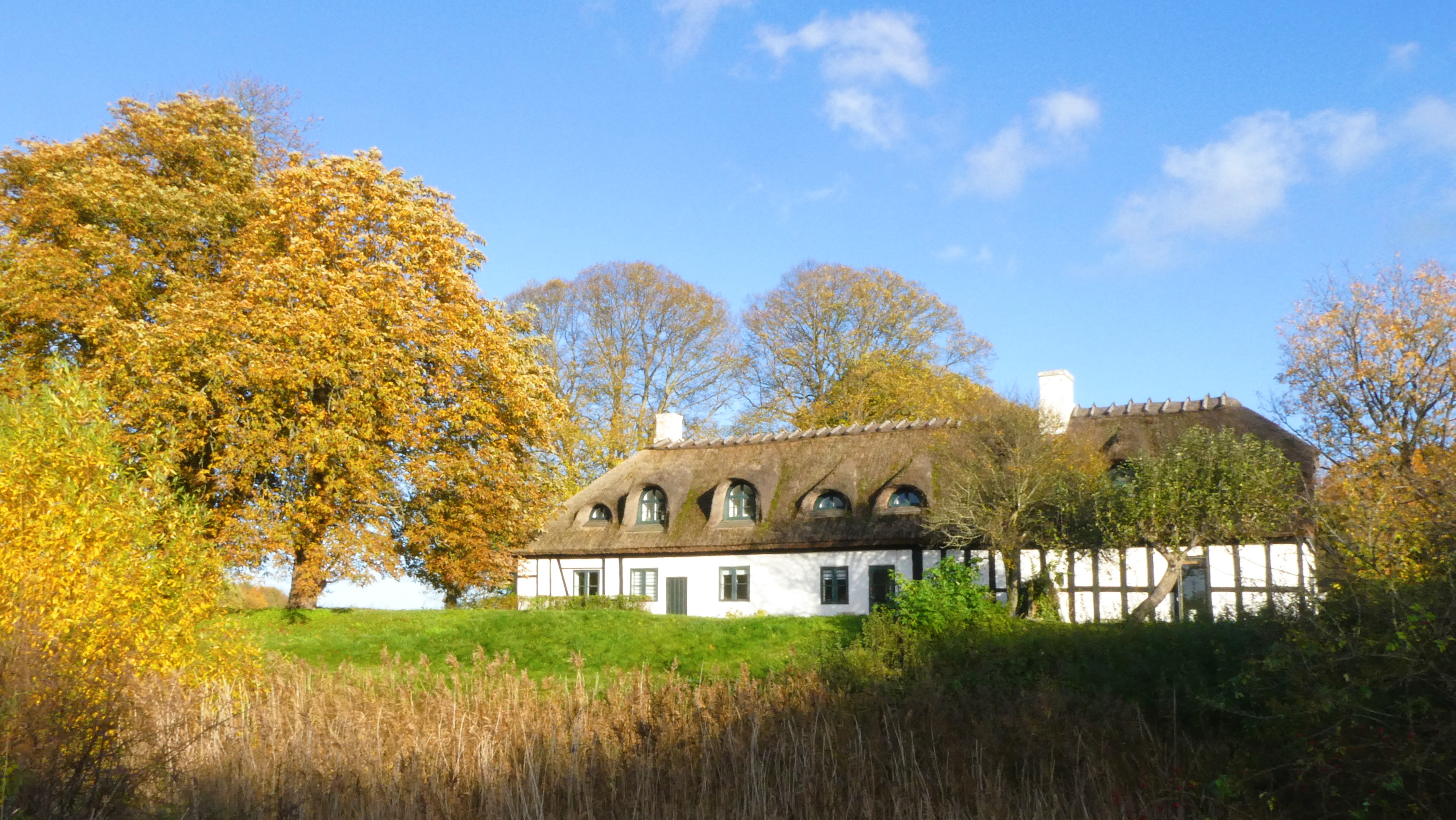
We are looking forward to this walk. Søllerød Naturpark always offers beautiful views. The walk passes the beautiful thatched farm: Rygård. To my surprise, I find that Olga, the last Grand Duchess of Russia, lived at Rygård after fleeing the Russian Revolution in 1917. There is always a story hidden somewhere. The exciting thing is finding it 😊😎
She moved to Rygård north of Copenhagen in 1930 with her husband and sons, after living in a small apartment in the Copenhagen. She enjoyed the peaceful and rural surroundings of Rygård, where she could paint and tend to her garden. She also befriended the local people and helped them with various tasks. She stayed at Rygård until 1948, when she left for Canada. Rygård is now part of the Søllerød Naturpark, a protected area of natural and cultural heritage.
Olga Alexandrovna was the youngest daughter of Emperor Alexander III of Russia and the sister of Nicholas II, the last tsar of Russia. She grew up in a tense political atmosphere, marked by several assassination attempts on her father and brother. She married Duke Peter of Oldenburg, in a loveless and unconsummated marriage. She later divorced him and married her true love, Colonel Nikolai Kulikovsky, with whom she had two sons. During the First World War, she served as a nurse and was awarded a medal for bravery. She witnessed the downfall of the Romanov dynasty in the Russian Revolution of 1917 and escaped with her family to Crimea, where they lived under constant threat of execution. Her brother and his family were brutally murdered by the Bolsheviks. She managed to flee Russia with her husband and sons in 1920 and joined her mother, the Dowager Empress, in Denmark. She moved to Canada in 1948, fearing Stalin’s regime, and died there in 1960. She was the last surviving member of the Romanov family.
A Danish writer, Martin A. Hansen developed a thesis stating that:
There has been a trade route, a military route and a pilgrimage route across Zealand, Denmark. Through wetlands, bogs, meadows, fields and forests.
“Not just a wheel track or horse trail, but a wide range of paths with shifts from century to millennium. It is traces of the first mound builders, the masters of dolmens, the passage graves, it is the Stone Age monuments on the valley stretches down toward the river estuaries, it is the elevated Bronze Age mounds, and finally, the Iron Age and Viking Age settlement and burial sites.” 1
1 Lethrica, The Historical Societies in Lejre Municipality, Volume 3, No. 8.
Years ago I decided to examing this 64 km trail. It was a joyful exploration of an area enriched with historical tales and great beauty. The walks became a beautiful journey through time and place. Unforgettable visits to the Vikings’ old port, Vellerup Vig; the hills in Egholm Forest with a view of Dronningedyssen towards Orø; crossing through Kyndeløse Nordmark with pleasant farmers and happy cows. Through the atmospheric Ejby Ådal and further up to Dyrehaven with a view of Tempelkrog. Continuing through Rye with its many well mounds. Out through Hestehaven and a detour down to the beautiful Aastrup and Elverdamsåen. Past the always full church in Kirke Såby. Over Roskilde Bakke and Kirkebakke to Helligrende and on to Abbetved, where I can still hear the call of the crows in the crisp autumn air. The thunderstorm raged as I walked along the beautiful path towards Sagnlandet Lejre. I could make out the Sacrifice Marsh between the trees, and the thunderstorm added to the scenery. The beautiful Knapsø with the grey-throated loons which emit strange cries. Through Herthadalen, where the first constitutional meeting was held on the 5th anniversary in 1854. Further through the historic Gl. Lejre towards Ramsødalen.
The villages around the Bridge of Fur offer beautiful country roads, wilderness trails, ancient monuments, idylls, a dozen lakes, many with fish. All in the most beautiful nature. At the bridge, the river flows briskly under towering pine trees.
The Bridge of Fur has a very special history that I love. The story should not be compared to the horrendous aggression on Ukraine.
The Bridge over Lyckebyån is a historic place. Here was the national border between Sweden and Denmark in 980-1658. In ancient times, the bridge was an important meeting place for people in the border areas.
“For over 600 years, the inhabitants lived at a national border, which they perceived as a penalty of sin. But no boundary marking could wipe out their community. Though at every outbreak of war, they were transformed into each other’s enemies. ” Vilhelm Moberg
Hence the peasants’ peace agreements: The parishioners of Fridlevstad in the south, and Vissefjärda in the north had promised each other not to follow their masters across the border, and not to go against each other by force or fire.
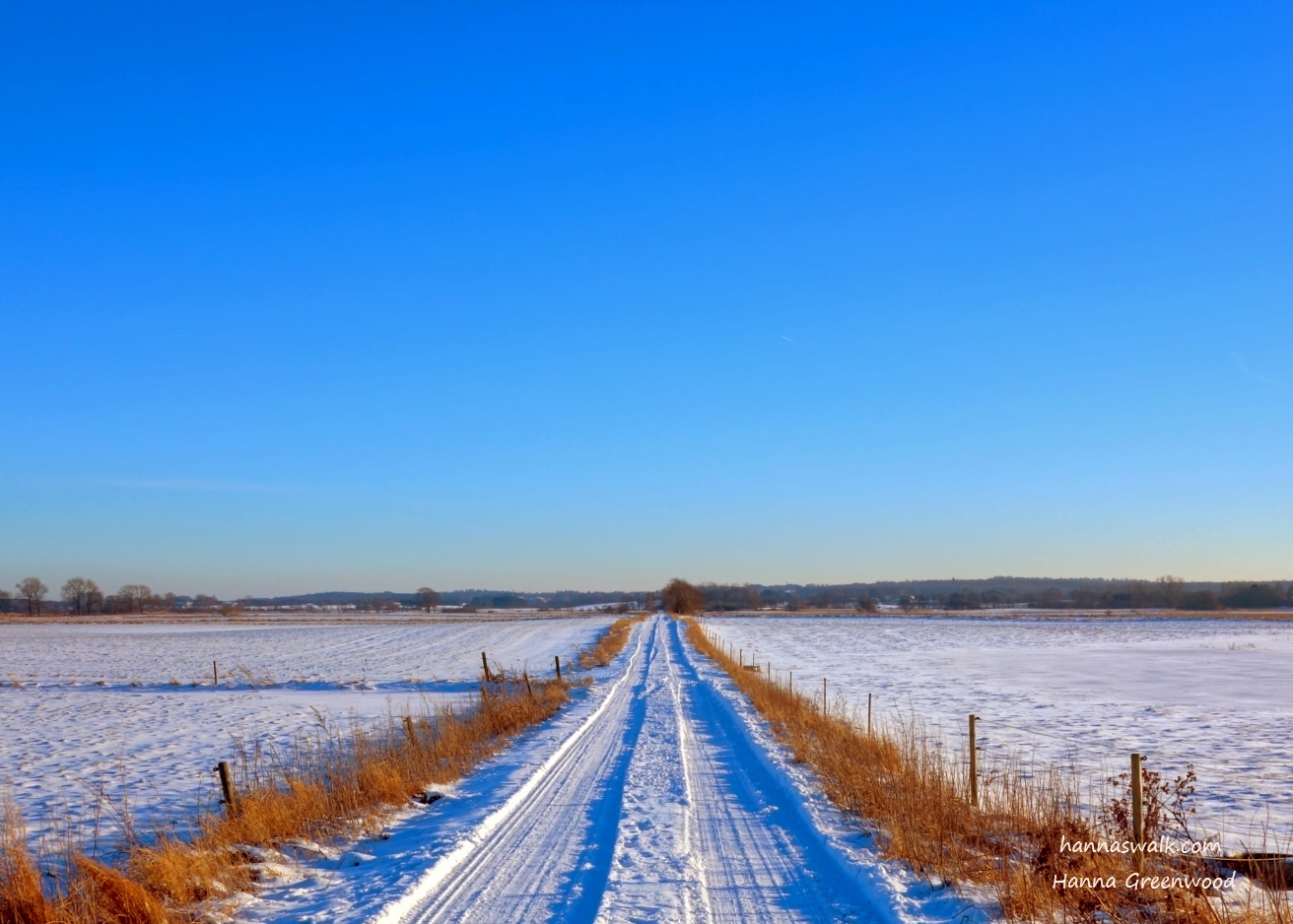
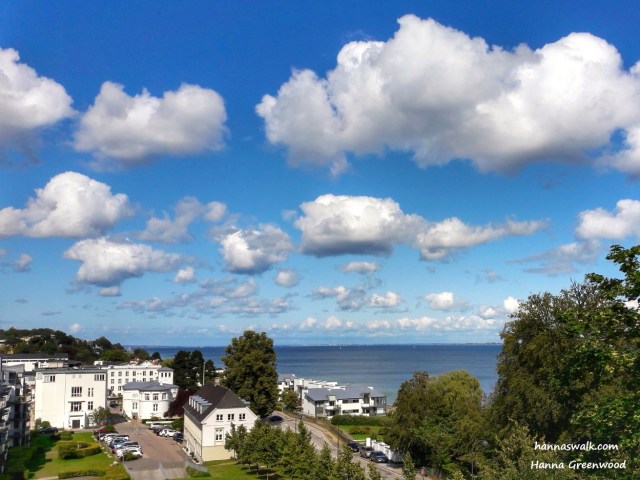
The light, the sky and the sea. We are in the northeast corner of Denmark. At the end of the snow-covered road lies Kronborg. Elsinore, home to the buzz of history. Kronborg Castle and William Shakespeare’s Hamlet.
Norwegian painter, Thomas Fearnley, 1802-1842 Helsingør mod Kronborg, vinter. Date of art: 1833, oil on canvas.
It was on a beautiful sunny day, that I went to see the ruins of Søborg Castle. Walking on these bare fields reminds me of the lake, that once was here many years ago.
The castle was one of Denmark’s largest and best fortified castles. It was built on an islet in the lake in the middle of the 11th century and was later conquered by the Viking, King Valdemar the Great.
Now the state will restore the lake: Take a peek below the post!
It might well have been here on the old lake bed of Søborg Sø that Andersen-Lundby got his inspiration for the painting: ‘Birds on the road’.
Note
The lake is to be restored over a number of years, to attract a diverse bird life and preserve the cultural-historical values around the lake. At the same time it will be an attractive place for outdoor life and reduce nutrient leaching.
The lake has been completely drained through an extended canal system since the 1870s. It was drained for agricultural purposes. The overall water levels in the region has been lowered 6-7 meters. The pumping layer comprises almost 600 ha.
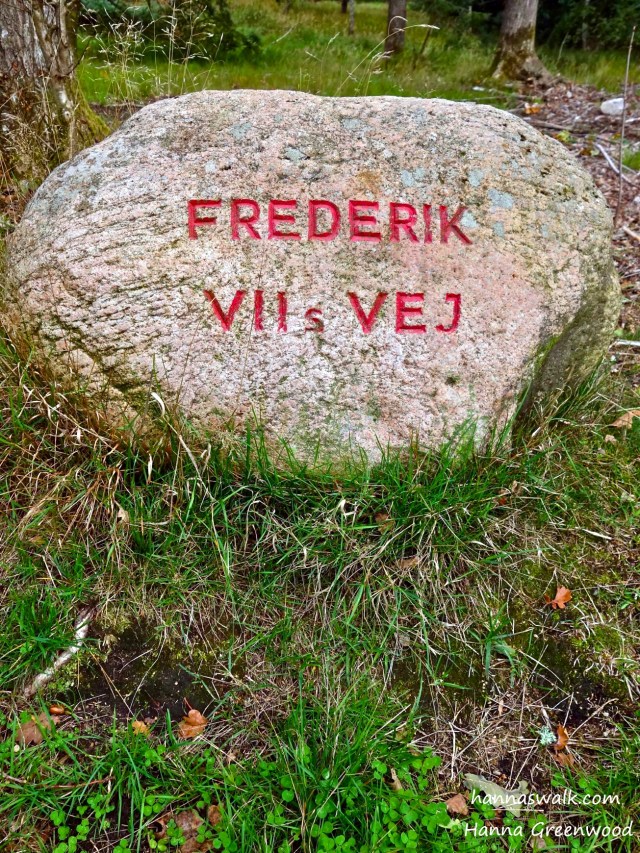
Several times I’ve seen King Frederik 7’s monogram on my walk in nature.
Or I stumble over stories that have emerged around his activities.
He was very fond of digging out burial mounds. Fortunately, he was assisted by very knowledgeable people so no harm was done.
None of which I’m aware of. But then I’m not an archaeologist either.
King Frederik the 7th of Denmark was a colourful personality.
His greatest interest was archaeology, representation and his third wife, ballerina Louise Rasmussen, Countess Danner.
Recently I visited Frederik 7′ cave in Skodsborg. It is well located overlooking the Sound and his Villa Rex.
He held gatherings in the cave and it is said that they were certainly not boring.
The day was incredible hot and people took the opportunity to take a swim in historic surroundings overlooking Kronborg Castle.
A spectacular choice if you ask me 😎











 HANNA'S WALK
You must be logged in to post a comment.