The badger is the largest predator in Denmark and can reach the age of 7 to 8 years.
We found this lovely badger dead on the railway tracks 3 days ago. Probably hit by the train in the early morning.
The badger is rather slow and noisy when looking for food, so it rarely captures healthy mammals and birds, but likes to take carrion.
It often find food within a range of 300-400 meters from the grave. The badger is a real troglodyte, who lives more than half his life down in the grave.
The badger gives birth to 2-3 cubs and raise them in the den. The cups are born in March, but they are not allowed to come out of the grave before May when they learn to seek feed together with their mother.
When have you last sought shelter from the rain under a tree in the forest?
Standing there when raindrops are falling on withered leaves and the scent of rain fills and enriches the air you breathe.
I did that a few days ago when the sun and rain in turn were stars on a beautiful March day.
“I remember a hundred lovely lakes, and recall the fragrant breath of pine and fir and cedar and poplar trees. The trail has strung upon it, as upon a thread of silk, opalescent dawns and saffron sunsets. It has given me blessed release from care and worry and the troubled thinking of our modern day. It has been a return to the primitive and the peaceful. Whenever the pressure of our complex city life thins my blood and benumbs my brain, I seek relief in the trail; and when I hear the coyote wailing to the yellow dawn, my cares fall from me – I am happy.” By Hamlin Garland, McClure’s, February 1899
Sometimes ‘smultronställer’¹ shows themselves in nature quite unexpected and Søllerød Naturpark never fails to make my spirit fly high and to remember certain moments.
Woodlands and fields lie above the golf course on Rygaard Overdrev. I love the hilly area. The nature park is a continuation of Rude Skov and invites for a walk.
We often went by public transport in the past, when we wanted to explore an area.
It gives you the opportunity to begin the walk in one place and end up in another.
One sunny day not long ago I took Bus 150 towards Kokkedal Station and got off at Gammel Holte. I continued down Gamle Holte Gade and turned left just before Gammel Holte Vej.
Sometimes the path reminded me of Cumbria, of pictures I have seen from the moor in England.
Soon the path disappeared in a little lake and though I was wearing Goretex I went round and not through the new lake in order to keep warm and dry. Soon I was in the forest, Rude Skov and after a nice walk past Løje Sø I ended my walk at Holte Train Station.
Once again I had an overwhelming feeling of a longer hike. That’s what a walk can do for me when I plan the walk in the right way.
You should try it your self should you get the chance.
E47 and E55, Helsingørmotorvejen
Gamle Holte Gade, Rudersdal
Søllerød Naturpark
Søllerød Naturpark
Søllerød Naturpark
Søllerød Naturpark
Søllerød Naturpark
‘Cumbria’ Søllerød Naturpark
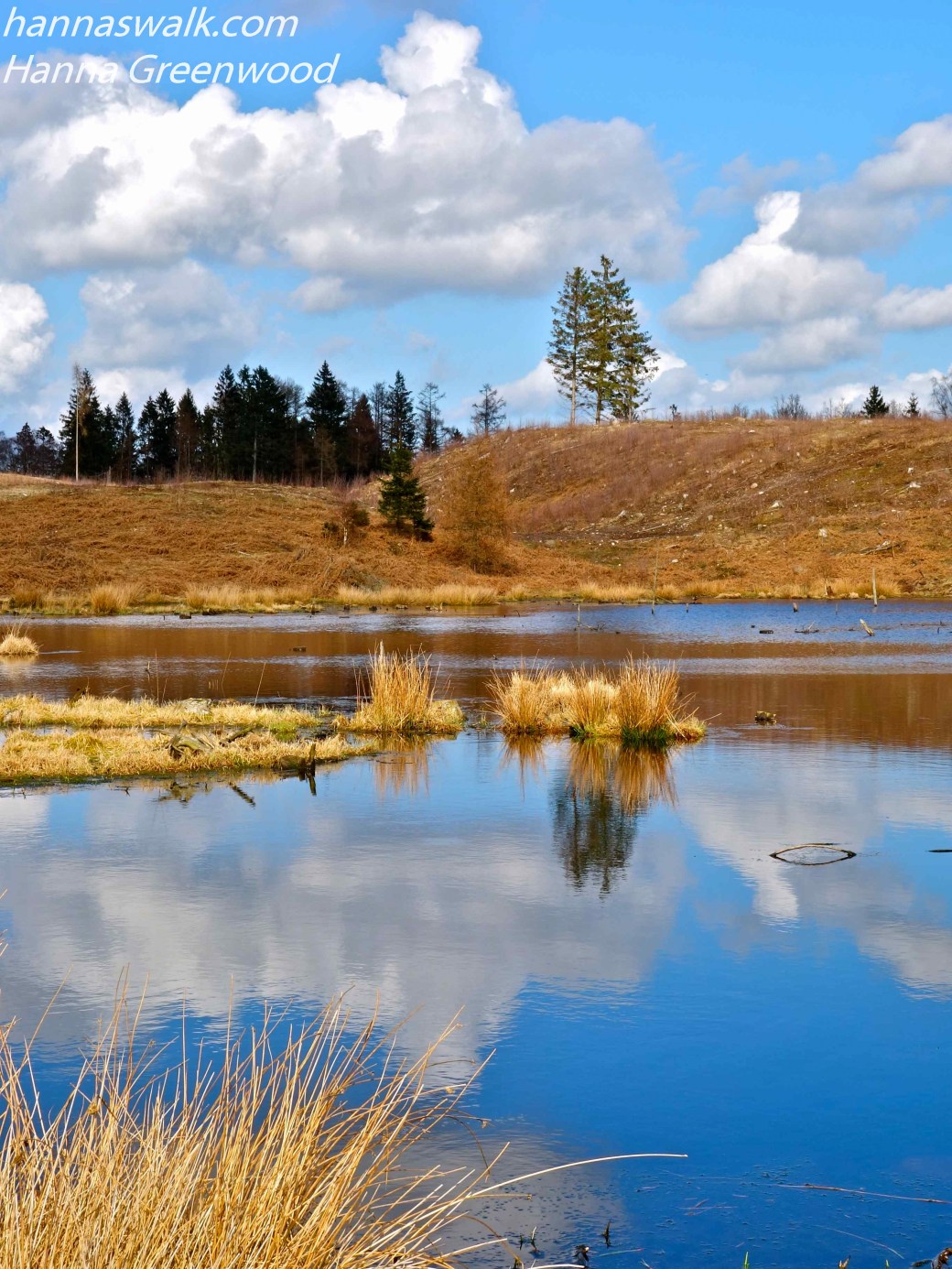
Søllerød Naturpark
Søllerød Naturpark
Søllerød Naturpark
Rude Skov, Rudersdal
Rude Skov, Rudersdal
Løje Sø, Rude Skov, Rudersdal
¹
A smultronställe is a Swedish term for a place that is an undervalued gem. A place to feel comfortable, and hard for others to find. Often a place with a personal and emotional value. Literally smultronställe means a place of wild strawberries.
This is a walk not a climb. Though only 82 meter above sea level the Danish mountain, Højbjerg is a beautiful place
From the top of Højbjerg you have a lovely view over the fields and treetops.
The Ice Age landscape was formed 15,000 – 12,000 B.C.
Two glaciers created a wonderful rolling scenery of hills and valleys, lakes and marshes. A great amount of melting ice created kettle holes, and the current lake Løjesø, was formed among many lakes.
A light exists in spring
Not present on the year
At any other period.
When March is scarcely here
A color stands abroad
On solitary hills
That science cannot overtake,
But human nature feels.
It waits upon the lawn;
It shows the furthest tree
Upon the furthest slope we know;
It almost speaks to me.
Then, as horizons step,
Or noons report away,
Without the formula of sound,
It passes, and we stay:
A quality of loss
Affecting our content,
As trade had suddenly encroached
Upon a sacrament. A Light Exists in Spring by Emily Dickinson
I went to the forest to find the beautiful horses at Sandskreds Soe, the horse in this post is from my hike in December.
Nevertheless the hike was stunning with the light that gleamed in lakes and hills, grasses and trees
Sandskreds Soe, Gribskov
Sandskreds Soe, Gribskov
Horse at Sandskreds Soe
Sandskreds Soe, Gribskov
Sandskreds Soe, Gribskov
Gribsoe, Gribskov
The train: Lokalbanen
Sunset at Gribsoe st.
Det lykkedes mig ikke at finde de smukke heste ved Sandskreds Sø, hesten i dette indlæg er fra min vandretur i december.
Ikke desto mindre var vandreturen fantastisk med lyset, der skinnede i søer og bakker, græs og træer.
_______________________________________________
Do not stand at my grave and weep: I am not there; I do not sleep. I am a thousand winds that blow, I am the diamond glints on snow, I am the sun on ripened grain, I am the gentle autumn rain. When you awaken in the morning’s hush I am the swift uplifting rush Of quiet birds in circling flight. I am the soft starshine at night. Do not stand at my grave and cry: I am not there; I did not die.
‘Do not stand at my grave and weep’ by Mary Elizabeth Frye
There’s a sunrise and a sunset every single day, and they’re absolutely free.
Don’t miss so many of them. By Jo Walton
______________________________
Rigtig dejlig vinterferie, og pas godt på hinanden ❤
I went for a walk in Hornbaek some days ago. The village is an old Fishermen Village. The wind blew cold along the beach but in the woods along the shore there were shelter and tranquillity. The area is very popular especial during the summer. The beach is attractive and the village is cozy with narrow streets and old houses.
Very soon spring will be here ❤
“It is spring again. The earth is like a child that knows poems by heart.” Rainer Maria Rilke
On an artificial island outside Dragør town is Dragør Fort, as part of Copenhagen’s Fortifications from the years around the 1880 to 1920.
Last time I was here, the sun shone and the sea glittered at every little ripple. The yellow houses with red tiled roofs stood in a wonderful contrast against the blue sky on this glorious summer day.
I was so interested in the many sights in the harbor, and had no time to take a closer look at Dragør Fort. But today it’s different, today the fort is my goal.
It’s bitterly cold, with a fresh breeze from the south, but the view is unique here on the top of Dragør Fort. Øresund Bridge is looming sharp against the blue sky and a large container ship looks as if it will topple down into the gap behind the horizon line.
Turning my back at the sea I have the opportunity to admire Dragør town 400 meters away on the mainland, and the houses lights up the landscape with the beautiful yellow masons and red tile roofs.
“Most of the fortifications were built between 1885 and 1894 in response to Denmark’s crushing defeat to Germany in 1864. During the first World War fortifications were manned by almost 50,000 soldiers. But when the war was over, the technological developments had outpaced the fortifications and the great defense ring was abolished as defense. “1. befaestningen.dk
Did you became curious about The Fortifications of Copenhagen? If so you will be able to read more about on this site: vestvolden.info
På en kunstig ø uden for Dragør by ligger Dragør Fortet, som en del af Københavns befæstning fra årene omkring 1880 til 1920.
Sidste gang jeg var her skinnede solen, og havet blinkede ved hver en lille krusning. De gule huse med de røde tegltage stod i en vidunderlig kontrast mod den azurblå himmel på den dejlige sommerdag. Jeg var optaget af de mange synsindtryk i havnen, og havde ikke tid til Dragør Fortet, men i dag er det anderledes, i dag er fortet mit mål.
Det er bidende koldt, med en frisk kuling fra syd, men udsigten er enestående her oppe på toppen af Dragør Fortet. Øresundsbroen aftegner sig skarpt mod den blå himmel, og store containerskibe ser ud, som om de vil vælte ned i gabet bag horisontlinjen. Vender jeg ryggen til havet ligger Dragør by 400 meter inde på fastlandet, og lyser i landskabet med med de smukke gule og røde farver.
“Hovedparten af Befæstningen blev opført mellem 1885 og 1894, som reaktion på Danmarks sviende nederlag til Tyskland i 1864. Under 1. Verdenskrig var Befæstningen bemandet med næsten 50.000 soldater. Men da krigen var slut, havde den teknologiske udvikling overhalet Befæstningen, og den store forsvarsring blev nedlagt som forsvarsværk.” 1. befaestningen.dk






 HANNA'S WALK
You must be logged in to post a comment.