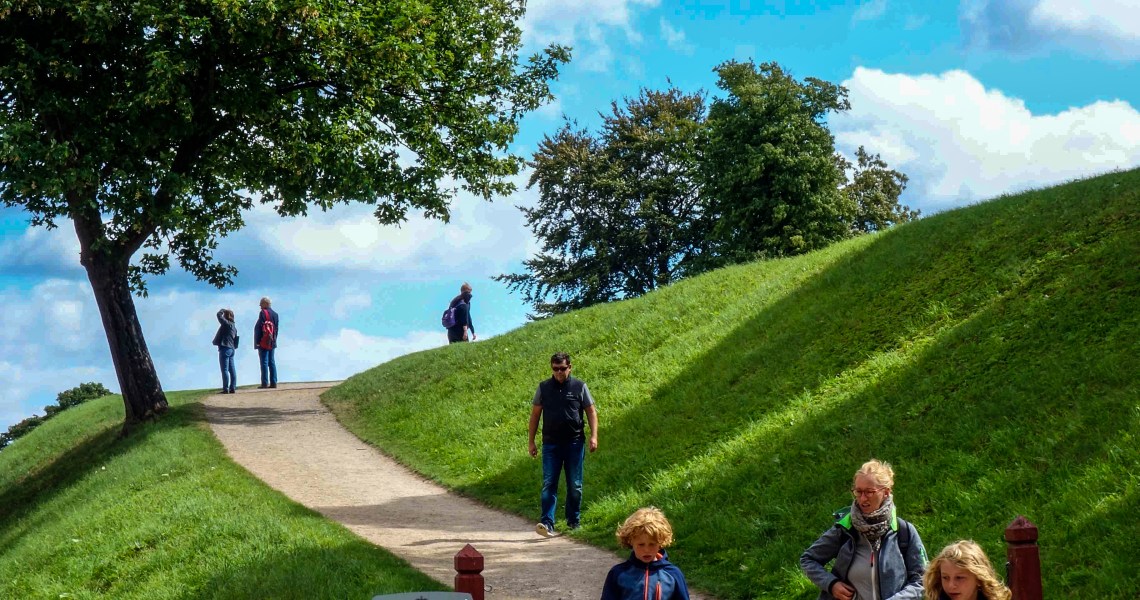
An Entertaining Stroll In The Citadel

I’m standing on top of the Citadel’s ramparts looking over the harbour while swallows fly closely by. I am sure the birds benefit from the steep ramparts one way or another.

Particularly two traditions link the Citadel to the public holiday, Stor Bededag and the night before.

Best known is the custom of eating warm wheat buns on Stor Bededags evening. The reason is that not even the bakers were supposed to work from sundown the night before Stor Bededag and throughout the following day.
Therefore very large wheat buns were baked the day before which people could take home to heat and eat the next day.

However, the wheat buns were eaten the same night – while they were still warm and crisp.
Today it is possible to buy the wheat buns all over when Stor Bededag is approaching.

The second tradition normally associated with Stor Bededag, was the habit of Copenhagen’s bourgeoisie walking on the ramparts on the evening of Stor Bededag. The custom can be traced back to the 1700s and is said to be caused by the melodious chimes of Our Lady Church’s carillon, which lured people of Copenhagen out on a stroll to enjoy the newly sprouted, spring green linden and chestnut trees.

The carillon was set up in 1747 and destroyed by the British bombardment in 1807 the church’s spire was hit and crashed into the main building, which burned completely.

It seems that the tradition once again is popular among people from Copenhagen and every day might work

Notes
Useful information on this site: Copenhagenet.dk
Kastellet
Kastellet, Copenhagen, Wikipedia

The Mythological Gefion

The Gefion Fountain never stops to fascinate me. I came here as a child with my mother. Now I’m back as an adult being a tourist in my home town.

Gefion

Notes

The fountain depicts the mythical story of the creation of the island of Zealand on which Copenhagen is located. The legend appears in Ragnarsdrápa, a 9th-century Skaldic poem recorded in the 13th century Prose Edda, and in Ynglinga saga as recorded in Snorri Sturluson’s 13th century Heimskringla.

According to Ynglinga saga, the Swedish king Gylfi promised Gefjun the territory she could plow in a night. She turned her four sons into oxen, and the territory they plowed out of the earth was then thrown into the Danish sea between Scania and the island of Fyn. The hole became a lake called Lögrinn and Leginum (locative). Snorri identifies the lake Löginn, as the lake of Old Sigtuna west of Stockholm, i.e., Lake Mälaren, an identification that he returns to later in the Saga of Olaf the Holy. The same identification of Löginn/Leginum as Mälaren appears in Ásmundar saga kappabana, where it is the lake by Agnafit (modern Stockholm), and also in Knýtlinga saga.

In spite of Snorri’s identification, tourist information about the fountain identifies the resultant lake as Vänern[1] ,[2][3][4] Sweden’s largest lake, citing the fact that modern maps show that Zealand and the lake resemble each other in size and shape.

Snorri, however, was well acquainted with Vänern as he had visited Västergötland in 1219. When he referred to this lake he called it Vænir[5] Wikipedia

Add Colour To My Sunset Sky

Today I took the consequence, and found my winter jacket from the attic.
Cold, rain showers and strong winds, forget the summer clothes.
At Langelinie I spoke with a woman from Trondheim in Norway. Few minutes before that heavy rain squall had driven past.
The weather forecast promised sun all day she exclaimed to my complaints about the weather and I understood her frustration.

There is nevertheless comfort to find in this weather with huge cumulus clouds as in the quote by Rabindranath Tagore

Clouds come floating into my life, no longer to carry rain or usher storm, but to add color to my sunset sky.
by Rabindranath Tagore

View from Langelinie towards Trekroner Fort

________________________________________________

Trekroner Fort is part of an old fortification. A defence for Copenhagen against the Germans and The British at the end of the 1800s.

KØBENHAVNS FORSVAR MOD KRIG OG KLIMAFORANDRINGER

A Bleak Summer

A walk in Rude Skov among raspberry and beetles.
‘There is a crack in everything.
That’s how the light gets in.’¹
– even through the dark clouds.

____________________________

¹. Leonard Cohen, Selected Poems, 1956-1968

The Blueberry Season

I shot the blueberry season underway yesterday. An early start for a delicious morsel. The characteristic for the blueberries are an upright, deciduous dwarf shrub with dark blue berries. Shrub is from 15 to 45 cm and is easily recognised because the branches are square, green and smooth. The leaves are 8-25 mm long, finely serrated, short-stemmed and green underside. Later in the year the leaves are often brown spotted. The flowers are first light, since red-green to completely red and sitting solitary in axils. The bloated jar shaped flowers are four to seven millimetres long; the stamens are smooth. The berries are six to eight mm, dark blue, or black glistening with a purple juice that reveals the blueberry eat socket when the lips are coloured blue – Very revealing, I might add.

Wish you all a good hunt!!!

Connected to the Sea

Even if you never have the chance to see or touch the ocean, the ocean touches you with every breath you take, every drop of water you drink, every bite you consume. Everyone, everywhere is inextricably connected to and utterly dependent upon the existence of the sea.
by Sylvia Earle

Kystvandring ved Kattegat

The Magic Fairy Land

Have you ever been out in field and woodland, by streams and lakes, by a tree all in blossom or a hedgerow laden with berries – and just felt sure that you were not alone?
That’s how Teresa Moorey introduce her book: The Fairy Bible.
I’m tempted to read the book because I feel deeply happy to live in a place much alike.
In these days the hawthorn blossoms on the field, Hvidtjørnesletten and makes an unforgettable impression on all beings.

I have been out there several times this week to experience the atmosphere once again.
One evening the field was kind of sacred. The scent of blossoming hawthorn was intoxicating and the quiet soothing sounds from the animals made the place magical.
The deer moved imperceptible between the hawthorns while they graze.
People seemed affected and stood still or spread a blanket just to sit and be in the present. They were lowering their voice and that might have been because of the fairies.

They were afraid to scare them away.
Over hill, over dale,
Thorough bush, thorough brier,
Over park, over pale,
Thorough flood, thorough fire!
I do wander everywhere,
Swifter than the moon’s sphere;
And I serve the Fairy Queen,
To dew her orbs upon the green;
The cowslips tall her pensioners be;
In their gold coats spots you see;
Those be rubies, fairy favours;
In those freckles live their savours;
I must go seek some dewdrops here,
And hang a pearl in every cowslip’s ear.

‘A Fairy Song’ by William Shakespeare

Sweet was the walk along the narrow lane
At noon, the bank and hedge-rows all the way
Shagged with wild pale green tufts of fragrant hay,
Caught by the hawthorns from the loaded wain,
Which Age with many a slow stoop strove to gain;
And childhood, seeming still most busy, took
His little rake; with cunning side-long look,
Sauntering to pluck the strawberries wild, unseen.
Now, too, on melancholy’s idle dreams
Musing, the lone spot with my soul agrees,
Quiet and dark; for through the thick wove trees
Scarce peeps the curious star till solemn gleams
The clouded moon, and calls me forth to stray
Thro’ tall, green, silent woods and ruins gray.

‘Sweet Was The Walk’ by William Wordsworth
________________________________________________________________

Fairy Bible by Teresa Moorey

The Deer Park

This is ten days ago now. The pictures are from a stroll in Jægersborg Dyrehave.
Since then the trees are beginning to turn green and the Mirabelle trees are blossoming with white flowers. Enjoy it while you can because this weekend the frost comes back with sleet and snow.

_________________________________

Jægersborg Dyrehave

The Highest Peak in North Sealand

We take a stroll in Rude Skov and set the course towards Maglebjerg which is the highest peak in North Sealand.
The leaves are still missing on the trees and the look between the branches are spectacular.
Maglebjerg is 91 meter above sea level and a popular route for mountain bikers.
Just before the ascent, we see a woman let herself fall off the bike and then lies with her head down in the withered leaves.
It turns out that it’s the preliminary exercise for extending the hip flexor, but it looked like an accident at first sight

On our way down from the hill we pass an old churchyard and a chapel. Under the gravestones rest mentally disabled children, many of them died very young.
The patients lived under miserable conditions. They were heavily medicated and during stimulated. Many of the patients were also misplaced.
In the middle of 70’erene criticism began to emerge, resulting in a gradual abandonment of the original institution. In 1999, the vacated old buildings were sold.

We meet a group of children from a kindergarten. There is no yelling or screaming but cozy talk about nature.

A boy is walking in the steep hillside. From his backpack clothes are hanging in a couple of plastic bags. Perhaps a wet sock or two 🙂
He moves conscious between roots, fallen branches and depressions in the forest floor. It’s a wonderful sight because the seeds for outdoor activities and pleasures of nature are laid here.
Two small girls are forming the rear guard under aware monitoring from one of the pedagogues. They have stones in their pockets and take turns to show the most peculiar or finest stone of them all. The girls have fun, play around and dance.

It’s well-being at its best.

danskebjerge om Maglebjerg
danskebjerge om København og omegn

Walk softly when you walk among Hawthorns

Walk softly or you might intrude the fairies.

A Hawthorn is considered a fairy tree, it is believed to be extremely bad luck to cut one down, remove branches, or even hang things upon it  in case you disturb the little folk.

The Hawthorn symbolizes fertility peace prosperity and binding. This tree is associated with sexuality and destruction. It was though that sleeping in a house with hawthorn blossoms would cause great misfortune.

Although on May Day the blossom are placed at the based of the May Pole.
The gathering of hawthorn blossoms was known has “goin a maying”.

In the legends of Cu Chulain a goddess pronounces a curse on him in crow form and flys to a thicket of hawthorns known has “hawthorn of the crow”. ¹.

¹. Ireland Calling

Happy weekend to all of you ❤ …and a joyous walk 🙂