The small ferry sailing around Frederiksborg Castle resembles undeniably a little boat from Legoland.
However, many people are having a joyous day on the lake with a different view to the castle
Recently I heard on the radio that the little boat is a rebuilt lifeboat from one of the most famous vessels in Danish history:
The ship Jutlandia, a floating hospital, that went on three expeditions from 1951 to 1953 during the Korean War.
That changed completely my perspective on the small ferry, until yesterday, when I did some research.
The shipping company tells the story on their website. The ferry has sailed the lake since 1952, and the story about the lifeboat is so popular that it has almost turned into a truth. Some myths are worth saving 🙂
Note
You can take a wonderful walk around the lake and through the Baroque garden or you can continue towards Gribskov and wilderness.
Click the link to see my beautiful walk towards the mountain in the forest:
We grasp a few apples from a wooden box, on our way down the stairs. The snowy roads are quiet, and the snow sparkles in the low sun. We park our bikes up against the trees leaning over the frozen lake.
There are all kind of people out skating. Old and youngsters and those in between.
We can hear the children screaming when one of them gets caught on the frozen lake. It’s a unified image of joy and desire for life.
The only light on the lake is the sun setting in the horizon and a few street lamps up upon the hill. Yet, it never gets completely dark. Later on the moon lights up the snow, and makes the evening unforgettable.
It is only when the cold overwhelms us that we find our way home after an experience of a lifetime.
This wonderful evocative painting from the Danish painter Anders Andersen-Lundby, refreshed one of many outings I had with my brother, when we were children.
When we had given our bodies to the wind, And all the shadowy banks, on either side, Came sweeping through the darkness, spinning still The rapid line of motion; then at once Have I, reclining back upon my heels, Stopp’d short, yet still the solitary Cliffs Wheeled by me, even as if the earth had roll’d With visible motion her diurnal round; Behind me did they stretch in solemn train Feebler and feebler, and I stood and watch’d Till all was tranquil as a dreamless sleep.
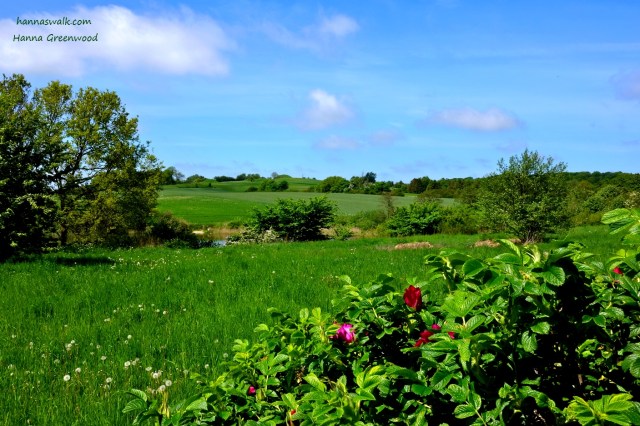
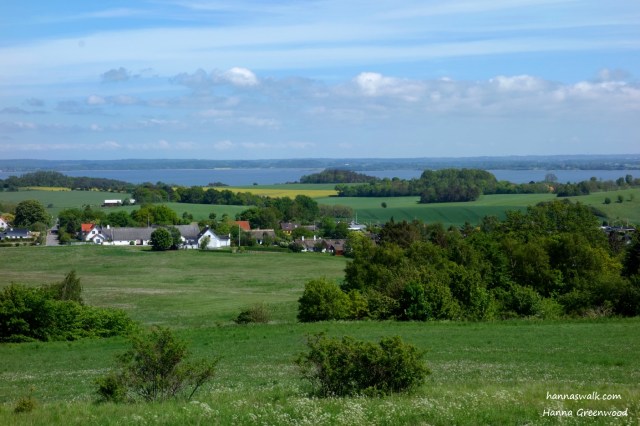
I don’t know about you but after a walk in the rain I found this great idea for a late summer walk in a glacial moraine landscape next to Arresø. We did the walk in the month of May, one of my favourite month.
Most of the surrounding land is made up of the last glacial moraine landscapes, but in addition there are widespread post-modern formations that are the result of land elevations, sea rises, water and wind erosion as well as sea and fresh water deposits, etc.
The central and southern part of the peninsula consists of a high-altitude, steadily hilly terrain with the highest point Maglehøj, 70 m above sea level, while the northern part consists of a low-lying, hilly terrain with the highest point of Little Maglehøj, 27 m above sea level : Naturstyrelsen
Arrenæs
Arrenæs
Arrenæs
Auderød Skov
Maglehøj, 70 meters above sea level
Arrenæs
Arrenæs
One of the 23 burial mounds on Arrenæs – Most of them from the Bronze Age
The holiest of all holidays are those Kept by ourselves in silence and apart; The secret anniversaries of the heart, When the full river of feeling overflows; – The happy days unclouded to their close; The sudden joys that out of darkness start As flames from ashes; swift desires that dart Like swallows singing down each wind that blows! White as the gleam of a receding sail, White as a cloud that floats and fades in air, White as the whitest lily on a stream, These tender memories are; – a fairy tale Of some enchanted land we know not where, But lovely as a landscape in a dream. Holidays by Henry Wadsworth Longfellow
‘If God in heaven will let me have Gurre, then I will let him have Heaven.’
Because of this blasphemy, King Valdemar is doomed to ride in Gurre every night
The romance and mystery associated with Gurre is created by many great poets.
The inspiration is easy to understand when you have wandered in Gurre and experienced the silence at dusk.
GURRESONGS:
The bluish twilight now damper
every sound of sea and land,
the fleeing clouds are encamped
to rest on the edge of heaven.
Compacted to soundless weight
is the forest airy stay
and the lake’s clear waves
have cradled themselves to rest.
In the west, the sun casts
from her radiant purple dress
and pulls over the waves
and dreams of the day’s splendour.
Not the smallest leaf is moving
and call upon my senses,
Not the slightest sound is heard
that seduced the senses to dance.
No, every power is lost
in the river of dreams
and pushes me gently and silent
back to myself…
Jacobsen, J. P., Samlede Værker III, 1924-29
I did a translation of the first verse, Gurresange, despite the risk of violate the treasure from Jens Peter Jacobsen’s pen.
Gurre Songs is written by the Danish poet; Jens Peter Jacobsen
Rainer Maria Rilke learned Danish and translated Gurre Songs to German
Twelve Tone Music inventor, Arnold Schoenberg, composed music to Jens Peter Jacobsen’s Gurre Songs (Gurrelieder premiered in 1913 in Vienna)
Where, twisted round the barren oak, The summer vine in beauty clung, And summer winds the stillness broke, The crystal icicle is hung.
Where, from their frozen urns, mute springs Pour out the river’s gradual tide, Shrilly the skater’s iron rings, And voices fill the woodland side.
Alas! how changed from the fair scene, When birds sang out their mellow lay, And winds were soft, and woods were green, And the song ceased not with the day!
But still wild music is abroad, Pale, desert woods! within your crowd; And gathering winds, in hoarse accord, Amid the vocal reeds pipe loud.
Chill airs and wintry winds! my ear Has grown familiar with your song; I hear it in the opening year, I listen, and it cheers me long.
We called it the Rain Valley, the Tavignano Gorge.
One day we drove through Corte, Corsica’s former capital and passed a view to a beautiful looking valley.
From the car I could see a path winding its way in the mountainside. The valley was sparkling green and beautiful. That kind of sights inspires me and as soon as we got back to our base I began to study our maps.
Next day we found our way into the wilderness and the Tavignano Gorge was spectacular lushly.
I was reminded of the Tavignano Gorge when McEff published the post from Andalusia: Chasing the Storm. A walk or some might call it a climb between the towns of Lanjarón and Órgiva. There are pictures in that post where you can see a trail, the GR 7 cuts across the cliffs of the gorge. I think our trail was paved, compared with the Andalucian GR7 trail.
Vi kaldte kløften for regnvejrsdalen, theTavignano Gorge.
En dag, da vi kørte gennem Corte, Korsikas tidligere hovedstad, passerede vi en meget smuk udsigt til en dal inde mellem bjergene.
Jeg fik øje på en sti, der snoede sig vej inde på den frodige bjergside. Sådanne syn inspirerer mig, og så snart vi kom tilbage til vores base begyndte jeg at studere vores kort.
Næste dag fandt vi vejen ind i Tavignano kløften, der var spektakulær frodig.








 ‘If God in heaven will let me have Gurre, then I will let him have Heaven.’


 HANNA'S WALK
You must be logged in to post a comment.