A thorough search of the weather radar didn’t remove the “shower symbols.”
Nevertheless, I could discern a window in the rain with a fair amount of optimism.
After all, who wouldn’t want to deceive themselves to get a breath of fresh air? 😄

A thorough search of the weather radar didn’t remove the “shower symbols.”
Nevertheless, I could discern a window in the rain with a fair amount of optimism.
After all, who wouldn’t want to deceive themselves to get a breath of fresh air? 😄
Some tourists were interviewed for today’s weather forecast:
We love Denmark and it is not too hot.
However, there is a but!
You never know whether it will be sunny or raining. Haha! Or how windy it is.
I took the chance between two thunderstorms and I made it home safe and sound.
I hope you have good weather, wherever in the world you are.

Lots of heavy showers today.
The branches were already there 🙂

The path meanders between rose hips and broom bushes. The sun is low, and the flowers glow in the evening sun. We hear a faint engine sound from the sea and see the silhouette of three men in a boat. Majestic clouds that look like mountains tower up behind them. It’s June’s unforgettable farewell, and a welcome to July. Enjoy summer and enjoy life ❤️


We passed the wreck on our holiday last week. The sight of it in the setting sun piqued my curiosity.
How did the cement ship go down?. And what happened to the people aboard.
Our lovely hosts sent us a link about the history of the area including the story about the wreck .
It was an interesting read.
I have chosen to focus the story on the shipwreck itself. The narrative is sober, and that only seems to heighten the drama.
But I am warning you. This is what is called a longread:

On December 29th, 1947, the tugboat S/S Castor left Hundested Harbor with the barge ‘Brøns Odde’ of Copenhagen towards Randers.
The barge was unusual while it was built of reinforced concrete in 1944 and not as usual of steel and iron or wood. It was therefore heavy and difficult to handle. The barge was ballasted according to the regulations for towing over open sea for such a vessel.
S/S Castor had a crew of 4 and on the barge ‘Brøns Odde’ there were 2 men for maneuvering and handling the tow rope.
The weather was nice and the sea was calm. When they were clear of Hesselø, the weather changed very quickly. It blew up into a northerly blizzard and visibility dropped to zero.
It was precisely in this difficult situation that the tow line snapped. The barge ‘Brøns Odde’ went into operation, and disappeared in the thickening snow.
As the S/S Castor had no radar and no radio, all communication between the two vessels was lost.
There was a temporary clearing in the weather, and from S/S Castor they were lucky enough to spot ‘Brøns Odde’, and ascertain that it had dropped its anchor.
S/S Castor therefore sailed as close to the barge as they dared, and remained there while they waited for an improvement in the weather and, in particular, for the high and violent waves to subside.
Instead of settling down, the storm increased in strength and ‘Brøns Odde’s’ anchor could not hold it in position. The barge drifted off in a south-westerly direction with its anchor dragging across the seabed.
Due to the depth conditions and the strong current and sea, S/S Castor did not dare to follow. The barge therefore disappeared in the darkness and new snow.
When it dawned the next day, the S/S Castor immediately began searching for her missing tow, and it didn’t take long to find it.
The barge was stranded at Yderby Lyng on the east side of Sjællands Odde, a peninsula on the northwest coast of Zealand.
S/S Castor approached cautiously ‘Brøns Odde’, but getting all the way in was not possible.
When the Master of S/S Castor had formed an overview of the situation, he sailed Castor to Odden Havn, where a solid dinghy was hired, and informed the shipping company and authorities about what had happened. The S/S Castor then sailed with the hired dinghy in tow to the beaching site where the tug anchored and then established a connection with ‘Brøns Odde’ via the dinghy as soon as the weather permitted. There was no risk for the two crew members on the barge.
In the following days the lake was still strong and caused swells around ‘Brøns Odde’ as when the wind and current changed direction and began to work on the land, causing the barge to leak. Sea and current also prevented S/S Castor from trying to pull ‘Brøns Odde’ off the ground. Moreover, local fishermen and skippers estimated that the S/S Castor was too weak to carry out the towing work, and in that the locals were right.
The shipowners, the crew of both S/S Castor and ‘Brøns Odde’ and some men the shipowners had brought from Copenhagen, worked eagerly, partly to seal ‘Brøns Odde’, partly to pump it bilge. Here again, it proved very difficult to seal a leak in a vessel that was built of reinforced concrete.
On 6 January 1948 the S/S Castor was moored for the night and with a lighthouse along the side of ‘Brøns Odde’, as it had been shown by soldering that the S/S Castor could well float to the outside, but with only 1 meter of water under the keel, a situation that was to become the indirect cause of S/S Castor’s sinking.
A storm now arose from the west which stirred the sea, and great waves came against the two vessels.
The driver of S/S Castor had been immediately reprimanded by the watchman and realized the acute danger the tow steamer was in.
The crew of S/S Castor quickly got the steam up and cast off from ‘Brøns Odde’ and steered out towards the open sea, to get clear of the now dangerous coast. At first it seemed that the S/S Castor would succeed in reaching deep water and riding out the storm from there. BUT?
Now the consequences of the fact that the S/S Castor had ventured into too shallow water became apparent. A few strong shocks from below up through the steamer told the crew with all desirable clarity that S/S Castor’s bottom had hit one or more large rocks. But still the steamer stood outwards with all the power that the machine could produce.
S/S Castor had received her fatal wound, although there were no more collisions with large rocks on the seabed, the ship had sprung a leak and the water rose rapidly in the engine room. S/S Castor’s Master let two men pump continuously, but the water ingress continued with ever-increasing force.
The engineer had to leave the combined engine and boiler room at the same time as the water reached the fire under the boiler and extinguished it.
When the escaping engineer came on deck and reported to the Master, it was clear to him that the S/S Castor was going to sink, no matter what was done to prevent it.
It was therefore about utilizing the steam that was left on the boiler, because the Machinist had not stopped the machine when he rescued himself from the engine room.
Resolutely, S/S Castor’s Master turned his ship towards land again, to try to sail it as far ashore, and as close to the shore as he could with the remaining steam in the boiler.
But the S/S Castor did not make it far. When the Engineer had to leave his engine room, S/S Castor had arrived approx. 900 meters from the coast, and here the ship then turned around, but only reached a distance of approx. 55o meters from the shore when the machine stalled for lack of steam and the S/S Castor sank deeper and deeper into the water playing at deck level.
At the same time, the storm had dropped to a stiff gale, and turned to the north-east, which certainly did not benefit the landing attempt.
It was at the last minute that the crew of the S/S Castor pulled the hired dinghy into the side of the tug and stepped into the dinghy and cut the tow rope to the S/S Castor.
A few minutes later, the S/S Castor went to the bottom in approx. 8 meter depth. The crew managed to sail the dinghy into Brøns Odde and got aboard it with difficulty, thus saving their lives.
There was a terrible surf on the coast, which of course would be dangerous to pass in the dinghy, as the shipwrecked quickly got proof of, as the dinghy broke free from its mooring at Brøns Odde and drifted into the surf, where it was immediately transformed into stick fires .
The shipwrecked were forced to stay on board the barge and wait for help from shore when tomorrow dawned.
The authorities ashore were well aware that something could have happened out at the stranded ‘Brøns Odde’ during the night of the storm. They did not fear the heavy cement laths, they believed that it would take more than a storm to destroy Brøns Odde’s solid cement construction, and to this day, it can be ascertained to be absolutely correct. Because Brøns Odde still lies where it laid to rest on the 30th. December 1947.
On the other hand, the S/S Castor and its crew were feared to the highest degree, because in contrast to the heavy cement lath, the S/S Castor was to a large extent comparable to a shuttlecock with which anything could very easily happen when it dared to go all the way into shallow water in such an unstable area in terms of weather and sea as was the case at Gnibenkrogen, where no one with local knowledge of the waters could dream of dropping anchor.
As soon as it was daylight again on the morning of January 6, 1948, many eyes and binoculars were directed towards the stranding site where ‘Brøns Odde’ lay just as it had the day before, but S/S Castor was gone and the sea empty. What had become of the S/S Castor, one asked themselves on land?
They did not remain in uncertainty for long, because help was signaled from ‘Brøns Odde’. The lifeboat from Yderby then went out to the wrecked barge, and took all five men on board and sailed them into Odden Havn to safety.
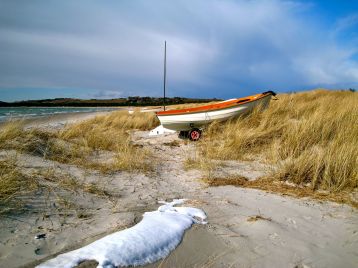
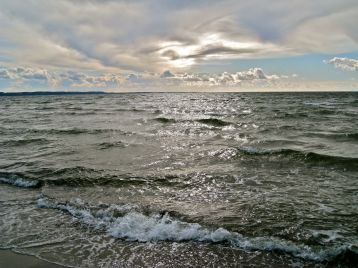
It was during an Easter that I took these pictures at Sjællands Odde and Sejerø Bugt.
The beaches of Sejerø Bugt are incredibly beautiful. The sea is fresh and the sky is clear. I love the sea in all seasons, but the time around Easter is remarkable.
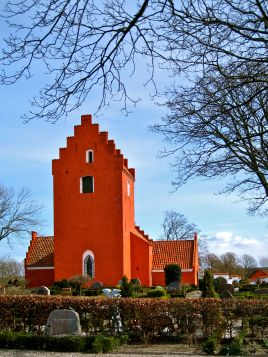
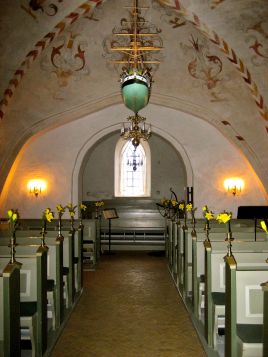
We went to see the wonderful Odden Kirke. The church is built around the year 1300. Three English pilots from the Royal Air Force are buried here.
They crashed over Sejerø Bay in 1944, and the bells were rung despite the Germans’ protests. The English pilots were honored by the entire local population, and the priest had to disguise himself as a gravedigger because he wasn’t allowed to carry out the burial for the occupying power.
Things turned out quite differently in 1808. At that time Denmark was at war against the English.
“Prince Christian Frederik – Denmark’s only ship of the line after the loss of the fleet in 1807 – was on its way from Helsingør to Store Bælt, in order to cover the transfer of French and Spanish troops to Zealand.
Prince Christian Frederik was pursued by three British ships of the line and two frigates.
In Samsø Belt, Prince Christian Frederik became aware that the English ships could not be avoided. It was decided to take up the fight in an attempt to get back to Sundet by taking advantage of good local knowledge and under the cover of night.
The battle began after sunset. Three hours later, the scuttled Danish ship of the line took the ground at Sjællands Odde and Prince Christian Frederik struck the flag.
Prince Christian Frederik had almost 200 wounded and dead – among the last Peter Willemoes (the hero from the Battle of Rheden in 1801).
A monument to Peter Willemoes, Dahlerup and Soland and many of their men is erected at the common grave of the fallen at Odden churchyard. They fell in the Battle of Sjællands Odde in 1808 against the English.
The day is solemnly celebrated every year with a memorial service in Odden Kirke and wreath-laying at the warrior’s grave and the memorial for Peter Willemoes.” * Forsvaret.dk


Vi besøgte Sjællands Odde og Sejerøbugten i en påske for år tilbage.
Strandene er utrolig smukke, havet er friskt, og himlen er klar.
Jeg elsker havet på alle årstider, men tiden omkring påske er noget ganske særligt.
Vi besøgte Odden Kirke den påske. Her ligger tre engelske piloter fra Royal Air Force begravet. De styrtede ned over Sejerøbugten i 1944, og der blev ringet med klokkerne trods tyskernes protester. De engelske piloter blev hædret af hele lokalbefolkningen, og præsten måtte forklæde sig som graver, fordi han ikke måtte foretage jordpåkastelsen for besættelsesmagten.
I det 18. århundrede var Danmark ikke så gode venner med englænderne. På de faldnes fællesgrav på Odden Kirkegård er rejst et monument over Peter Willemoes, Dahlerup og Soland samt mange af deres mænd. De faldt i Slaget ved Sjællands Odde i 1808 mod englænderne.
“Prinds Christian Frederik – Danmarks eneste linieskib efter tabet af flåden i 1807 – var på vej fra Helsingør til Storebælt for at dække overførslen af franske og spanske tropper til Sjælland.
Prinds Christian Frederik blev undervejs forfulgt af tre britiske linieskibe og to fregatter.
I Samsø Bælt blev Prinds Christian Frederik klar over, at man ikke kunne undvige de engelske skibe. Det blev besluttet at tage kampen op i et forsøg på at komme tilbage til Sundet ved at udnytte det gode lokalkendskab og i ly af nattemørket.
Kampen begyndte efter solnedgang. Tre timer senere tog det sønderskudte danske linieskib grunden ved Sjællands Odde og Prinds Christian Frederik strøg flaget.
Prinds Christian Frederik havde næsten 200 sårede og døde – blandt de sidste Peter Willemoes (Helten fra Slaget på Rheden i 1801).
Dagen højtideligholdes hvert år ved en mindegudstjeneste i Odden Kirke og kransenedlæggelse ved krigergraven og mindesmærket for Peter Willemoes.” Forsvaret.dk
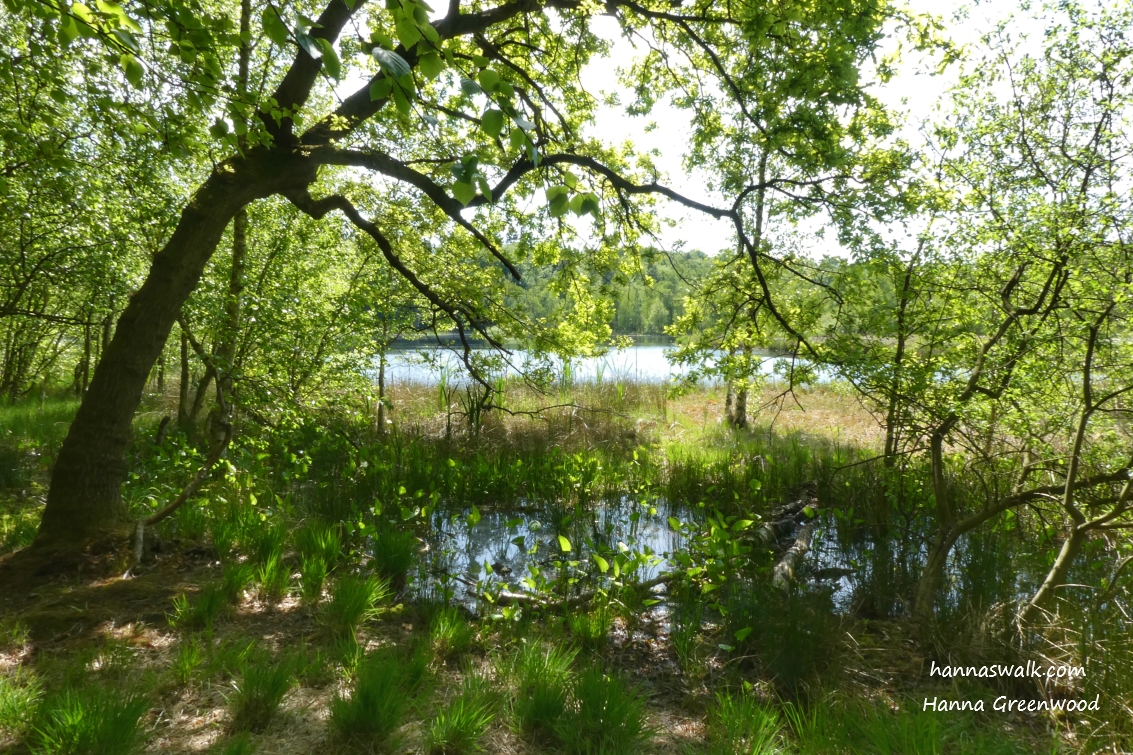
A wonderful place in the forest, where the beautiful hawthorn is blooming at this very moment.

We often find exciting snakes, birds and plants here in the bog.
The wind direction must be right and we must not make too much noise 😊


‘The Way through the Woods’ by Rudyard Kipling:
“They shut the road through the woods
Seventy years ago.
Weather and rain have undone it again,
And now you would never know
There was once a road through the woods
Before they planted the trees.
It is underneath the coppice and heath,
And the thin anemones …”
The forests are the most used leisure facilities in Denmark. 90 percent of all adult Danes go for a walk in the forest at least once a year * ❤️

* Dansk Skovforening
Something must have frightened the deer. Suddenly they came running straight towards me. It was really scary for a brief second until they turned away from me and calmed down. Whew!

 HANNA'S WALK
You must be logged in to post a comment.